
Best Daily Skincare Routine for Acne-Prone Skin
Taking care of acne-prone skin doesn’t have to mean buying dozens of products or following a complicated routine.
In fact, using too many products at once can sometimes make it harder to understand what your skin actually needs.
A better approach is to build a simple routine and follow it consistently.
Your basic routine can include three important steps:
- Gentle cleansing
- Moisturizing
- Sun protection
Depending on your skin and the type of acne you experience, an appropriate acne treatment may also be added.
In this guide, we’ll explain how to build a practical morning and evening routine, what types of products to look for, common mistakes to avoid, and when professional advice may be appropriate.
Why Does a Skincare Routine Matter?
Acne develops through several interacting factors, including oil production, dead skin cells, clogged follicles, bacteria, inflammation, hormones, and genetics.
If you haven’t already read our explanation of the underlying causes, see our guide:
[What Causes Pimples? A Complete Beginner’s Guide]
A consistent skincare routine cannot eliminate every possible cause of acne, but it can help you keep your skin clean, support the skin barrier, and use appropriate treatments when necessary.
The key word is consistent.
Changing your products every few days makes it difficult to determine what is helping or irritating your skin.
SKINCARE ROUTINE OVERVIEW
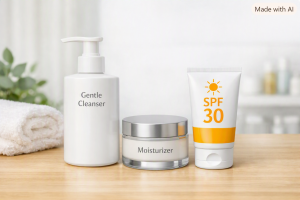
Step 1: Choose a Gentle Cleanser
Cleansing is the foundation of most skincare routines.
A cleanser helps remove:
- Excess oil
- Sweat
- Makeup
- Sunscreen
- Dirt and environmental debris
However, your cleanser doesn’t need to leave your skin feeling extremely tight or “squeaky clean.”
That tight feeling can be a sign that your skin is being over-cleansed or irritated.
What should you look for?
For acne-prone skin, consider a cleanser that is:
- Gentle
- Suitable for your skin type
- Non-comedogenic when possible
- Easy to rinse
- Free from ingredients that you know irritate your skin
If you have sensitive skin, a fragrance-free option may be worth considering.
How Often Should You Wash Your Face?
For many people, cleansing twice a day is reasonable:
Morning
Wash away oil and sweat that accumulated overnight.
Evening
Remove makeup, sunscreen, oil, and environmental debris from the day.
You may also want to cleanse after heavy sweating or exercise.
However, repeatedly washing your face throughout the day isn’t necessarily better.
If your skin becomes dry, irritated, or uncomfortable, consider simplifying your routine.
Step 2: Use an Appropriate Acne Treatment
If you experience acne, you may choose to include an acne treatment in your routine.
Different ingredients target different acne-related problems.
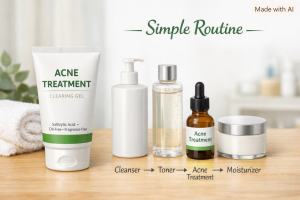
One commonly used ingredient is salicylic acid, which can help exfoliate inside pores and may be useful for certain types of acne.
Other acne treatments may contain ingredients such as benzoyl peroxide or topical retinoids.
However, acne treatments aren’t one-size-fits-all.
Some ingredients can cause dryness or irritation, particularly when you first start using them.
Always follow the product instructions.
If you have persistent, severe, or painful acne, professional medical advice is preferable to continually experimenting with products yourself.
ACNE SKINCARE PRODUCT
Step 3: Moisturize Your Skin
Many people with oily or acne-prone skin make the mistake of avoiding moisturizer completely.
But oily skin can still become dehydrated or irritated.
A suitable moisturizer can help support the skin barrier and improve comfort.
When choosing one, look for characteristics such as:
- Lightweight texture
- Non-comedogenic formulation
- Suitable for your skin type
- Minimal irritation
You don’t necessarily need an expensive moisturizer.
The best product is one that works comfortably with your skin and that you can use consistently.
Step 4: Protect Your Skin From the Sun
Sunscreen is an important part of daytime skincare.
Choose a broad-spectrum sunscreen that you are comfortable using regularly.
If you have acne-prone skin, a non-comedogenic sunscreen may be preferable.
Sun protection is especially important if you’re using certain acne treatments because some treatments can increase sensitivity to sunlight.
Apply sunscreen according to the product’s instructions and reapply when appropriate for your situation.
SUNSCREEN

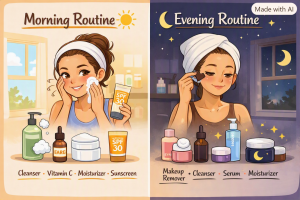
A Simple Morning Routine
Here’s an easy routine that doesn’t require a large collection of products.
Step 1 — Cleanse
Use a gentle cleanser.
Step 2 — Acne treatment
If you use a morning treatment, apply it according to the product instructions.
Step 3 — Moisturize
Apply a suitable moisturizer.
Step 4 — Sunscreen
Finish with broad-spectrum sunscreen.
That’s it.
You don’t need to add another five or ten products simply because they’re popular online.
A Simple Evening Routine
Your evening routine can be equally simple.
Step 1 — Remove Makeup
If you wear makeup, remove it before cleansing.
Step 2 — Cleanse
Gently wash your face.
Step 3 — Acne Treatment
Apply your chosen treatment according to its instructions.
Step 4 — Moisturize
Finish with moisturizer.
MORNING AND EVENING ROUTINE
What About Blackheads and Whiteheads?
Blackheads and whiteheads are both forms of clogged pores, but they are not exactly the same.
Blackheads are open comedones, while whiteheads are closed comedones.
If you’re interested in understanding the difference in more detail, read:
[Blackheads vs. Whiteheads: What’s the Difference?]
Understanding the type of breakout you’re dealing with can help you choose more appropriate skincare.
How to Prevent Your Routine From Making Acne Worse
A good skincare routine isn’t only about what you use.
It’s also about what you avoid.
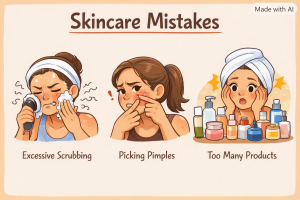
Avoid aggressive scrubbing
Scrubbing harder doesn’t necessarily make your skin cleaner.
It can cause irritation and make existing inflammation more noticeable.
Avoid picking and squeezing
Repeatedly touching, squeezing, or picking at pimples can irritate the skin and increase the chance of marks or scarring.
For more prevention tips, read:
[How to Prevent Pimples Without Damaging Your Skin]
Avoid changing everything at once
If you introduce five new products simultaneously and your skin becomes irritated, you won’t know which product caused the problem.
Introduce changes gradually whenever possible.
How to Introduce a New Skincare Product
Adding a new product to your routine should be a gradual process.
Start with one product
Instead of changing your entire routine overnight, introduce one new product at a time.
Follow the instructions
More product doesn’t necessarily produce better results.
Follow the recommended amount and frequency.
Watch for irritation
Pay attention to:
- Burning
- Significant redness
- Severe dryness
- Swelling
- Persistent discomfort
If you experience a concerning reaction, stop using the product and seek appropriate medical advice.
What Does “Non-Comedogenic” Mean?
You’ll often see the term non-comedogenic on skincare and cosmetic packaging.
It generally means that a product is formulated to be less likely to clog pores.
This can be useful for people who frequently experience clogged pores.
However, everyone’s skin is different.
A product labeled non-comedogenic can still cause irritation or breakouts in some individuals.
Therefore, don’t rely on the label alone. Pay attention to how your own skin responds.
Do Expensive Products Work Better?
Not necessarily.
An expensive skincare product isn’t automatically more effective than an affordable one.
What matters more is:
- Appropriate ingredients
- Suitable formulation
- Correct use
- Consistency
- Your individual skin needs
A simple routine that you actually follow is often more useful than an expensive collection of products that you rarely use.
Common Skincare Mistakes
Mistake 1: Washing Too Often
Over-cleansing can cause dryness and irritation.
Mistake 2: Using Too Many Active Ingredients
Combining several strong acne treatments may irritate your skin.
Mistake 3: Skipping Moisturizer
Oily skin can still benefit from moisturizing.
Mistake 4: Skipping Sunscreen
Sun protection is an important part of general skin health.
Mistake 5: Picking Pimples
Picking can cause additional irritation and increase the risk of skin damage.
Mistake 6: Expecting Immediate Results
Most skincare routines require time and consistency.
COMMON SKINCARE MISTAKES
When Should You See a Dermatologist?
A skincare routine can be useful for managing mild acne, but some situations require professional attention.
Consider seeing a dermatologist or other qualified healthcare professional if:
- Acne is severe.
- Pimples are deep or painful.
- Acne keeps returning despite consistent care.
- You are developing scars.
- Over-the-counter treatments aren’t helping.
- Your skin has a persistent or unusual reaction.
- Acne is significantly affecting your daily life or confidence.
A dermatologist can identify the type of acne you have and recommend appropriate treatment.
Frequently Asked Questions
What is the best skincare routine for acne-prone skin?
A simple routine usually includes gentle cleansing, appropriate treatment when needed, moisturizer, and daytime sunscreen. The exact products depend on your skin and the type of acne you experience.
Should I wash my face three or four times a day?
Usually, more cleansing isn’t necessary. Excessive washing can irritate the skin. Many people do well with cleansing in the morning and evening, plus cleansing after heavy sweating when appropriate.
Should people with oily skin use moisturizer?
Yes. Oily skin can still benefit from moisturizer. Look for a lightweight, non-comedogenic option if clogged pores are a concern.
Can skincare completely prevent pimples?
No routine can guarantee that you will never develop a pimple. Acne can be influenced by hormones, genetics, and other factors outside your control.
How long should I try a skincare routine?
The appropriate timeframe depends on the products and the condition being treated. Follow product instructions and avoid constantly changing your routine. If acne persists or becomes worse, consider professional advice.
Is natural skincare always better?
Not necessarily. “Natural” doesn’t automatically mean safer or more effective. Some natural ingredients can irritate sensitive skin.
What matters is whether a product is appropriate for your skin and supported by reliable evidence when making treatment claims.
Building a Routine You Can Actually Follow
The most important part of skincare isn’t having a huge collection of products.
It’s creating a routine that fits your lifestyle.
A practical routine could be as simple as:
Morning
Cleanser → Moisturizer → Sunscreen
Evening
Cleanser → Acne Treatment → Moisturizer
You can adjust this based on your skin type and any professional recommendations.
The goal is consistency rather than complexity.
Final Thoughts
A good skincare routine for acne-prone skin doesn’t need to be complicated.
Start with the basics:
- Cleanse gently.
- Avoid aggressive scrubbing.
- Use appropriate acne treatments when needed.
- Moisturize regularly.
- Protect your skin from the sun.
- Choose products that suit your skin.
- Avoid picking and squeezing pimples.
- Introduce new products gradually.
- Be patient and consistent.
Remember that acne is influenced by many different factors, including hormones and genetics. Having occasional breakouts doesn’t mean you’re doing something wrong.
If your acne is severe, painful, persistent, or leaving scars, professional medical advice can help you find a treatment approach that is appropriate for your situation.